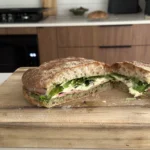
Same Day Ciabatta
A simple recipe for a same day ciabatta that can be made in 4 hours from start to finish. No biga or starter required - perfect for those who are a little impulsive, like myself.
Servings: 2 loaves
Equipment
- Stand mixer
- Bench scraper
- Proofing bowl or box
- Spray bottle filled with water
- 2 x baking sheets
- Parchment paper
- Measuring spoons/digital scale
Ingredients
- 300 ml lukewarm water roughly 114-115f
- 1 tsp 4g instant dried yeast
- 1/2 tsp 4g honey
- 75 g dark rye flour
- 250 g strong bread flour - I use Manitoba Oro
- 1 tsp 5g salt
Instructions
Mixing and kneading (35 minutes)
- Mix yeast and honey with 200ml water. Leave for 10 minutes until you start to see some activity.
- Using a stand mixer - combine the two flours and yeast mixture. Mix on low with the paddle attachment until just combined then leave to rest for 15 min.
- Turn the mixer back on low and gradually add the remaining 100ml water over 2-3 min.
- Once combined add the salt and mix for another 2-3 min on low.
- Switch to dough hook and knead for 5 min, starting slowly then increasing the speed to medium for the last couple of minutes.
Stretch and folds (60 minutes)
- Transfer to lightly oiled bowl/container (I like to use a large rectangular shaped Tupperware to help with forming the shape), cover and rest for 30 min then perform one set of stretch and folds:
- Wet your hands with water and scoop underneath one side of the dough.
- Stretch that portion of the dough upwards, then fold it over towards the centre of the bowl.
- Rotate the bowl 45 degrees and repeat until you’ve gone around all sides of the dough.
- Tuck the top left corner (10 o’clock) over to the bottom right corner (4 o’clock) a couple of times, until the folded seams are now underneath.
- Cover the dough again and rest for another 30 minutes, then perform dough lamination:
- Wet your work surface generously with a spray bottle
- Gently tip out the dough. Carefully pull and stretch each side to form a thin rectangle against your work surface.
- Fold the left side over in 1/3, then fold the right side over the left. Start at the top end of the dough and roll it up downwards towards yourself to create a neat package.
Bulk ferment (60 minutes)
- Place the now laminated dough back into your container, cover and bulk ferment for 1 hour.
Shaping and final proof (90 minutes)
- Generously flour your work surface and the top of the dough.
- Use a bench scraper to carefully release all of the sides of the dough before gently tipping it out onto the floured surface (floured side down), and once again flour the side of the dough facing up.
- Use your hands to tuck any sides in - very lightly - to ensure it’s roughly squared - but be careful not to knock any air out of the dough.
- Using a bench scraper, split the dough into two and carefully but quickly lift each one onto a piece of parchment paper.
- Cover with a clean tea towel and leave for a final proof for one hour.
- Meanwhile, preheat your oven to 250c /230c fan and let it heat up over the final proofing period. Place a baking tray in the bottom third of the oven, and another (upside down) in the top third - we’ll use this one in lieu of a baking stone.
- Get several ice cubes ready and your spray bottle on hand ready to go.
- Once the dough has had its final proof, use a chopping board or similar like a pizza peel and moving quickly slide each one on its parchment paper, onto the upside down tray at the top of the oven. The parchment paper will make this easier to do.
- Immediately throw the ice cubes on the bottom tray and spritz the loaves and top/sides of oven with water - about 7-8 sprays. Closing the oven door immediately.
- Bake for 12 minutes, then remove the tray with now melted ice cubes in it.
- Bake for a further 15 minutes.
- Remove the loaves from the oven and cool on a wire rack before enjoying.
Notes
Note on flour: you can substitute the rye flour for bread flour (for a total of 325g) but if doing so, reduce the water to 288ml.
