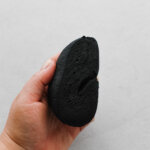
Squid ink pasta dough
Squid ink pasta dough! Jet black in colour with a wonderful, oceanic flavour profile (think more seafood-like and less fishy). This is a real show stopper of a pasta dough - perfect for lightly dressed seafood pastas!
Servings: 2 servings (approx 380g)
Ingredients
- 250 g soft wheat flour tipo 00
- 2 large eggs approx 55g each (aiming for roughly 110g egg weight)
- 20 g squid ink
Instructions
- Place the flour in a mound on your work surface and make a well in the centre. Pour the eggs and the squid ink into the well and using a fork, slowly begin to whisk until eggs and squid ink have come together.
- Start incorporating a little bit of flour at a time, whisking vigorously until you have a thick jet black custard-like consistency.
- Switch to a bench scraper, starting in front of you scoop up some flour from the outer edge and flip it over the centre. Use a chopping motion to cut the flour into the egg mix. Repeat, moving around all sides of the flour.
- Once you have a shaggy dough, use your hands to press into a ball. It might be a bit crumbly at first but keep going, and once you can see and feel a ball form starting to take shape, it’s time to knead.
- After 5 minutes of kneading, cover the dough in something airtight and let it rest for 5-10 minutes. This will allow the dough to rehydrate and the gluten relax.
- Return to the dough and continue kneading for another 5-7 minutes. The dough should be smooth and elastic, and not sticky at all.
- Cover the dough again and let it rest for a minimum of 30 minutes at room temperature before rolling and shaping.
- If you need to leave your dough for longer, rest it in the fridge and bring it to room temperature before rolling and shaping.
Notes
We're aiming for a hydration point of around 51% here. If your eggs weigh slightly more or less than 55g each, then you can adjust the amount of flour needed using this ratio e.g. let's say you have 120g of eggs, and 20g of squid ink then your liquid quantity is 140g, so you can adjust the amount of flour and increase it to roughly 275g.
While the squid ink shouldn’t stain your hands, it can stain a wooden pasta board (trust me :D) so I recommend making this on a non-porous surface if you aren’t prepared for the clean up.
To clean my board I scraped it down to remove as much excess, then used lemon and salt to scrub clean, followed by wiping it down with a damp j-cloth. Finally I left it to dry in the sun.
