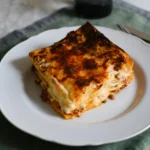
Classic Lasagne
Here is my recipe for a classic (albeit not traditional!) lasagne - using a pork and veal ragu, and the addition of melty mozzarella between layers!
Servings: 6 servings - makes one 30cm pan
Ingredients
Pasta
- 1 x batch of my master pasta dough
Veal and Pork Ragu
- 4 tbsp extra virgin olive oil
- 1 brown onion finely diced (equating to roughly 1 cup)
- 2 celery sticks finely diced (equating to roughly 1/2 cup)
- 1-2 medium-large carrots finely diced (equating to roughly 1 cup)
- 4 garlic cloves slightly crushed
- 1 kg veal/beef and pork mince 50/50
- 200 ml whole milk
- 2 tbsp tomato paste/puree
- 200 ml red wine
- 2 x 400g tins of whole peeled tomatoes – drained of their juices
- 400 ml beef stock
- 3-4 bay leaves
- Parmesan rind if you have one, but optional!
Besciamella (béchamel) and cheese for assembly
- 100 g unsalted butter
- 100 g flour – tipo 00 or all-purpose
- 1200 ml whole milk
- Fresh nutmeg ground if you can’t find fresh! – optional
- Low hydration mozzarella the melty kind – not buffalo – a couple of big handfuls once grated
- Parmigiano Reggiano – a couple of big handfuls once grated
Instructions
Pasta
- Make the pasta dough.
- Once rested, divide the dough into four pieces. Work with one at a time (keeping the rest covered to prevent them from drying out) – flatten the piece with your hand or a rolling pin before passing it through the thickest setting on your pasta machine. Fold the edges in to create a neat rectangle that fits the width of your pasta machine, and run it through the thickest setting again until your dough is uniform in shape
- Continue passing your dough through the machine, working through each thickness setting until you get to setting 6 or 7, depending on your preference for thickness. I like to go with setting 6, personally.
- Use your baking dish as a measuring guide and cut the rolled sheets of pasta into rectangles that will fit the base on the tin – I find I need two rectangles per layer for a 30cm pan. You’ll want at least 10 sheets to be able to create 5 pasta layers.
- Re-roll any scraps to avoid wastage, and set your cut lasagne sheets aside, covered with a clean tea towel.
Veal and Pork Ragu
- Finely dice the carrot, celery and onion. Smash the garlic cloves.
- Heat olive oil in a large saucepan and gently sauté the veg for around 10 minutes before adding the garlic cloves and cook until fragrant.
- Crumble in the veal and pork mince and use a whisk to help break it up in the pan. Salt generously.
- The meat will release its juices – let it reduce, then add the milk and again allow this to almost entirely reduce. This will take some time – don’t rush it – stir occasionally.
- Next make a space in the pan and add the tomato paste/purée – allow it to cook out for a minute or so, then tip in the red wine – reduce by 2/3.
- Finally, add the tinned tomatoes (remember to strain them from the juice), beef stock, a few bay leaves and a parmesan rind if you have one.
- Bring to a boil, then cover and simmer for around 2-3 hours, stirring occasionally, until the liquid has reduced and you’re left with a luscious ragu. If you find your ragu is drying out, add a splash of water/beef stock as needed. You don’t want this to be crumbly and dry, it should still be moist and have nice movement in the pan.
- Discard the bay and Parmigiano rind and set aside until you’re ready to assemble your lasagne.
Besciamella (béchamel)
- Melt the butter in a saucepan and whisk in the flour until a roux forms (a paste). Allow this to cook for a good 2-3 minutes so as to “cook out” the flour.
- Add the milk – I do this cold – whisking continuously until it’s combined with the roux, then over a gentle heat allow this to cook and thicken, stirring often (this is important).
- To know when it’s the right thickness and consistency, coat the back of a wooden spoon with the besciamella and draw a finger through the sauce – it should leave a clean parting. I try not to take it too far as it tends to thicken when in the oven – when dropped from a spoon it should leave a trail momentarily but not remain gloopy in the pan.
- Remove from the heat and grate in a couple of pinches of fresh nutmeg, and season with salt to taste.
- Set aside and make sure you keep this covered to prevent a skin forming on the besciamella as it cools slightly – I press a piece of clingfilm directly onto the surface until assembly.
Assembly
- Preheat the oven to 180c (350F/160c Fan).
- Bring a large pot of water to a rolling boil and salt generously.
- Working in small batches, cook the lasagne sheets for 30 seconds before transferring onto a clean tea towel.
- Once cool enough to handle, it’s time to assemble
- for your base layer, start with a couple of spoonfuls of ragu on the base of your dish followed by a couple of dollops of besciamella, then a layer of pasta.
- Next, add ragu, besciamella and a smattering of the grated cheeses (both mozza and parmigiano) – sometimes I like to also add slices of the mozzarella for extra cheesiness… this is of course optional.
- top with another layer of pasta and repeat the process – pasta – ragu – besciamella – cheese – until you get to your last sheet.
- Use what’s left of your ragu followed by a generous amount of besciamella (reserve some for this final layer!) – you want the pasta sheet fully covered. Cover with a whole heap of the cheeses.
- Bake in the oven uncovered for around 70-80 minutes, then switch to the grill setting for a couple of minutes until the top is crispy and the edges are bubbling.
- Allow the lasagne to cool for at least 15 minutes before serving.
