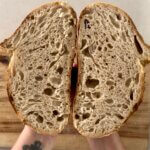
Sourdough bread
The sourdough recipe that's gotten me hooked on baking my own bread every week. It's got a lovely, custardy-crumb and crisp exterior. Perfect for sandwiches!
Servings: 1 loaf
Ingredients
- 120 g peak starter I feed mine the night before so I can start the process first thing in the morning to allow for a longer cold ferment before baking.
- 420 ml water
- 400 g white bread flour
- 200 g whole bread flour
- 12 g fine salt
- 10 ml water
- QB semolina flour for dusting the banneton
Instructions
Fermentolyse (60 minutes)
- Combine the starter, 420ml of water and both flours, mixing for a couple of minutes with a dough hook, or by hand until you have a shaggy mass.
- Cover and rest for 60 minutes.
Add salt and first rest (30 minutes)
- After the dough has rested, it's time to add the salt. Sprinkle over the salt on the top of the dough, followed by the remaining 10ml of water.
- Use your fingers to press/dimple it into the dough, then using a sort of scoop and slapping motion, mix it in by hand.
- Once the salt is incorporated into the dough, cover the bowl and set a timer for 30 minutes then start your first set of stretch and folds.
Stretch and folds (2 hours)
- Wet your hands with water and scoop underneath one side of the dough.
- Stretch that portion of the dough upwards, then fold it over towards the centre of the bowl.
- Rotate the bowl 45 degrees and repeat until you’ve gone around all sides of the dough.
- I like to then finish the set with two coil folds - carefully slide both hands under the dough and lift it up, before placing it back down.
- Rotate the bowl 45 degrees and repeat for a second coil fold.
- Cover the dough again, and let it rest for another 30 minutes before performing second set of stretch and folds.
- Repeat every 30 minutes until you've done 5 sets total, or until the dough passed the window pane test.
The window pane test is when you take a pinch of dough and carefully stretch it out as thin as possible between your hands - if you can stretch it thin enough that you can see light through it (like a window pane), then it passes. This test allows us to determine whether the gluten network has developed enough.
Bulk ferment (variable subject to your dough and envrionment - ~4-5 hours)
- Now it's time to bulk ferment - this is probably the trickiest bit to get right as it really depends on your environment. Personally I find from first mixing my dough to being ready for pre-shaping it will take around 7.5-8.5 hours depending on how cool it is. While testing my kitchen has recorded about 21-23c in temp.
You can use the aliquot method to help determine when your dough is read for pre-shaping. Take a pinch of dough off and place in a small glass of water. Once the dough floats, it's ready.
Pre-shaping (35 minutes)
- Once the dough has had time to ferment (it should have increased in volume and bubbles will be visible under the surface of the dough), carefully tip it out onto a clean work surface and shape into a ball.
- Pull the sides of the dough out to form a rough rectangle, fold the right side to the middle, then the left side to the middle, then the top side to the bottom until the seams are now facing down.
- Place the bench scraper in your dominant hand, cup your other hand around the dough. Use your hand to help guide the dough, and the bench scraper to under and around the dough starting from the side closest to you, pulling back towards you when you reach the further side.
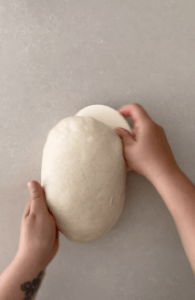
- Shape the dough however you wish - I have been enjoying the double caddy clasp method where you fold the left and right side of the dough to meet, then repeat the motion but now with the bottom and top ends.

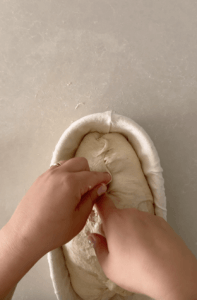
- Place the dough into a floured banneton - semolina or rice flour work really well here, and stitch the dough to tighten by pulling the outer edges of the dough to the centre and "stitching" them together.
Cold ferment (overnight - min 9 hours)
- Cover the banneton and place in the fridge overnight - I use a cloth cover but you could also use a clean shower cap.
Baking (1 hour 25 minutes)
- The next morning, preheat your cast iron pan in a 250c fan-forced (270c conventional/480f) oven for 40 minutes.
- Tip the dough out onto a sheet of parchment, score it and place in the preheated pan. Quickly spritz all over with water and place the lid back on and bake for 25 minutes.
- Remove the pan from the oven and take the lid off. Turn the oven down to 220c fan-forced (240c conventional / 425f) and return the bread to bake for another 20 minutes.
- Remove from the oven and allow to cool over 4-6 hours before slicing.
