

Pork Ragu
This pork ragu recipe is rich, meaty and deeply flavourful while remaining wonderfully low maintenance. Give it about 20 minutes of attention upfront, then leave it to bubble away gently on the stovetop for a few hours. I make mine with a combination of pork mince and pork and fennel sausages, slowly cooked with a soffritto of onion, carrot and celery, red wine, tomatoes, stock and a splash of milk. A Parmigiano rind thrown into the pot is optional, but highly encouraged if you have one hiding in the fridge!

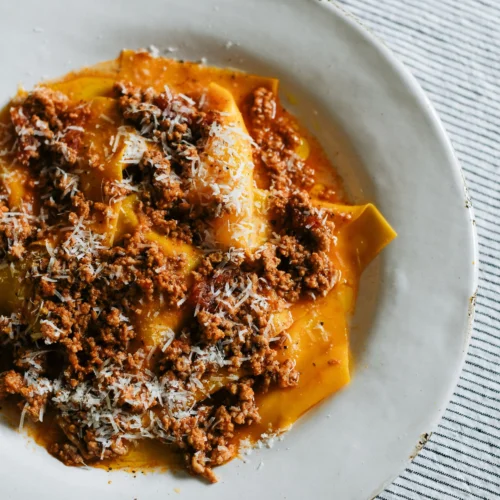
My favourite way to serve this pork ragu recipe is, of course, with homemade silk handkerchief pasta. Those delicate, silky sheets catch the sauce wonderfully, but honestly, this ragu is good enough to keep on rotation for just about any pasta night.
If slow-cooked sauces are your thing, try my short rib ragu with gnocchi or this milk-braised three pork ragu next.

What is Ragu?
Ragu, or ragù, is an Italian meat-based sauce that is cooked slowly until it becomes rich, concentrated, and full of flavour. There are countless regional variations throughout Italy, with different combinations of meat, wine, tomato and milk depending on where you are and who is cooking.
For example, bolognese is a type of ragu, but not every ragu is Bolognese. Ragu is the broader term for slowly cooked Italian meat sauces, with the ingredients and preparation varying considerably from region to region.
The key is that this isn’t a quick tomato sauce with a little meat stirred through it. The meat is the star of the show, and time does most of the heavy lifting.
For my version, I use both pork mince and Italian pork and fennel sausages. The mince gives the sauce plenty of body, while the sausage brings extra fat, seasoning and fennel flavour. Everything then gets a long simmer until the sauce has reduced and the flavours are concentrated. It’s the perfect Sunday dinner!

Key Ingredients You’ll Need
- Pork mince – Don’t go for the lean stuff here. A fattier pork mince gives the ragu far more flavour and keeps the meat tender throughout the long cooking time.
- Pork and fennel sausages – Remove the sausage meat from the casings before adding it to the sauce. I love the extra richness and flavour fennel sausage brings to the pork, but a good-quality Italian pork sausage works well, too.
- Onion, carrot and celery – The base of our sauce. I blitz these into a purée rather than chopping them so they melt right into the ragu as it cooks. Picky eaters don’t even notice they’re there!
- Garlic – Skip pre-minced garlic and use whole cloves for the best flavour. I slightly crush the cloves and add them after the vegetables have had a few minutes to soften.
- Red wine – Use something you’d happily drink. I like a Sangiovese, which adds plenty of depth without overpowering the pork.
- Tomato puree and whole tomatoes – A combination of concentrated tomato puree and tinned whole tomatoes gives us just enough tomato flavour without turning this into an overly tomato-heavy sauce.
- Beef stock – This adds another layer of savoury flavour and gives the sauce plenty of liquid for its long simmer. I recommend low-sodium stock so you have more control over the final flavour of the dish.
- Whole milk – Milk rounds everything out, adding richness and helping to mellow the acidity of the wine and tomatoes.
- Bay leaves – Three bay leaves slowly infuse the sauce as it cooks. Just remember to fish them out before serving!
- Parmigiano rind – Optional, but one of my favourite little tricks. If you have a leftover Parmigiano Reggiano rind in the fridge, throw it into the pot and let it simmer with the sauce for an extra savoury hit.

How to Make Pork Ragu
For a dish that tastes so complex, this pork ragu recipe is surprisingly simple to make. It does require a bit of time, but most of it is hands-off. Just combine the ingredients and let the sauce simmer away.
- Fry the veg. Blitz the onion, celery, and carrot into a purée. Then, fry the mixture in olive oil until tender. Add the garlic, and cook just until fragrant. Be careful not to let it burn!
- Cook the pork. Crumble the pork mince into the saucepan, breaking it up with a whisk. Salt the pork generously. Then, once it starts to release its juices, add the red wine and let it bubble away until reduced by half.
- Combine ingredients. Stir through the tomato paste, whole tomatoes, and stock.
- Add the sausage. Squeeze the sausage meat out of the casings into a bowl, and break it up with a whisk.
- Combine and cook. Crumble the sausage into the sauce, add the bay leaves, Parmigiano rind, and milk. Cook on low, stirring occasionally, until the sauce is thick, rich, and concentrated. I often add an extra splash of broth here and there if it becomes too thick.
- Serve. Discard the bay leaves and Parmigiano rind. Then, spoon the ragu over your pasta of choice, and enjoy warm!
My Favourite Ways to Serve
My favourite pairing for ragu with pork is my silk handkerchief pasta. Rolled paper-thin and cut into delicate squares, the silky folds become coated in the rich sauce, making for the perfect bite.
That said, this pork ragu recipe is incredibly versatile. Use my master pasta dough, and try the ragu with pappardelle, tagliatelle, rigatoni, or another pasta shape sturdy enough to stand up to the rich sauce! No matter the pairing, don’t forget to top your dish with extra Parmigiano Reggiano before serving.
Then, add a crunchy green salad and a loaf of sourdough bread for a hearty comfort meal.
Make-Ahead, Storage, and Freezing
Ragu is one of those wonderful dishes that arguably tastes even better the next day.
- Make-ahead: Make the pork ragu a day or two ahead, let it cool completely, then transfer it to an airtight container in the fridge. Reheat it gently on the stovetop before serving.
- Fridge: Once cooled, transfer leftover pork ragu to an airtight container and refrigerate for up to 3-4 days.
- Freezer: Portion the cooled ragu into airtight freezer-safe containers and freeze for up to 3 months. I like freezing it in individual or two-person portions so I can pull out exactly what I need for an easy pasta dinner.
- Reheating: Defrost frozen ragu overnight in the fridge, then warm it gently in a saucepan until piping hot throughout. Add a splash of stock or water as needed to loosen the sauce before tossing it through your pasta.
Pork Ragu Recipe
Ingredients
Silk Handkerchiefs
- 300 g tipo “00” flour
- 250 g egg yolks roughly 14 eggs – save the whites for omelettes or pavlova!
Pork Ragu
- 1 brown onion
- 2 celery sticks
- 1 medium-large carrot
- Olive oil
- 3 garlic cloves slightly crushed
- 1 kg pork mince don’t go for a lean mince – fat is gold
- 1.5 cups red wine like Sangiovese
- 140 g tomato puree
- 1 can tinned whole tomatoes drained and rinsed of their juices
- 2 cups good quality beef stock
- 4 Italian/pork and fennel sausages
- 3 bay leaves
- Parmigiano rind optional
- 1 cup whole milk
- Parmigiano Reggiano to serve
Instructions
Silk Handkerchiefs
- Place the flour in a mound on your work surface and create a well in the centre. Add the egg yolks into the well, then using a fork begin to whisk, slowly incorporating a bit of flour at a time until the mix comes together as a shaggy dough.
- Knead for 10 minutes until the dough is smooth and elastic, and not sticky at all. Egg yolk doughs are drier so after a few minutes of kneading, cover and rest for 5-10 minutes to allow the dough to rehydrate, before continuing your knead. Give the dough a spritz with water during the kneading process as required to help it into a workable mass.
- Cover or store the dough somewhere airtight and leave to rest for at least 30 min.
- Cut the dough into four pieces. Working with one at a time, (keeping the other pieces covered while you do) use a pasta machine to roll the dough out until it’s roughly 0.6mm thick (typically the second to last setting on most machines – setting 8 on a Marcato Atlas).
- Cut the sheet of dough into 8x8cm squares with a straight wheel cutter or knife to create your silk handkerchiefs.
- Lay the handkerchiefs out on a tray lined with a clean tea towel or dusted with fine semolina and allow them to dry out for at least an hour before cooking.
Pork Ragu
- Blitz the onion, celery and carrot into a puree.
- Heat olive oil in a large saucepan and gently fry the pureed veg for around 5 minutes before adding the garlic cloves and cook until fragrant.
- Crumble in the pork mince and use a whisk to help break it up in the pan. Salt generously.
- Once the pork starts releasing its juices, add the red wine and let it reduce, before throwing in the tomato paste, whole tomatoes and stock.
- Squeeze the sausage meat out of its casing into a bowl and use the same whisk trick to break the meat up, before crumbling it into the sauce.
- Add the bay leaves and Parmigiano rind, if using, and a cup of milk.
- Allow this all to bubble away on the lowest possible heat for 3-4 hours, stirring occasionally – add a touch more stock if needed but you want this to reduce.
- Discard the bay and Parmigiano rind before serving.
Finishing touches
- Bring a large pot of generously salted water to boil.
- The silk handkerchiefs cook incredibly quickly – they’ll only need a minute or so.
- Allow a cup of ragu per person – add this to a smaller pan and keep warm.
- Scoop the silk hankies out of the boiling water with a slotted spoon and add directly to the ragu. Gently toss to coat.
- Divide between bowls and serve with a crack of black pepper and grated Parmigiano.


